Kanban
The Kanban view shows your data as cards in stacks on a board. To move a card to a different stack, drag it. This section gives all the operations for the Kanban view.

Copy a prompt, paste it into NocoAI in any base, and replace the words in [brackets] with your own.
- Create a kanban view of this table stacked by [Status]
- Create a kanban view of [Deals] stacked by [Stage] that shows only my deals
- Add a [Stage] single select field and create a kanban view stacked by it
Kanban View Actions
- Create a New Kanban View
- Rename an Existing Kanban View
- Duplicate a Kanban View
- Remove a Kanban View
- Share a Kanban View
- Lock Kanban View for Edits
Kanban View Operations
- Rearrange Fields Within the Kanban
- Show or Hide Fields Within the Kanban
- Apply Filters to Display Specific Records on the Kanban
- Sort Records on the Kanban by One or More Criteria
- Perform Quick Searches for Specific Data Within Fields
- Export Data to CSV or Excel Format
- Change Cover Image
- Show or Hide field Labels on Cards
Kanban View Stacked-by field Operations
Fields That Can Stack a Board
A Kanban board stacks its cards by one field of the table:
| Field | Stacks |
|---|---|
Single select | One stack for each option of the field. |
User that holds one person | One stack for each person with access to the project. |
Link that points to one record (Many to One) | One stack for each record of the linked table. |
Cards with no value in the stacked-by field go to the Uncategorized stack.
A User field that holds several people cannot stack a board, and neither can a Link field that points to several records. A Many to One link field can stack a board only when the data source of the table is PostgreSQL. On other data sources, the Kanban view lists the field, but you cannot select it.
With a Single select field, you can add, rename and delete the stacks of the board, because each stack is an option of the field. With a User or a Link field, the stacks come from the data instead, so the board has no stack to add, rename or delete. A Link field loads 50 stacks at a time. To load the rest, click Load more stacks at the end of the board. The stack of a person who no longer has access to the project is read-only, so you cannot drop cards into it.
Change Stacked by Field
To change the field that stacks the records in the kanban view:
- In the toolbar, click the
Stacked bymenu. - Click the name of the current stacked-by field.
- In the dropdown, select the new field to stack the records by. To stack the board by a field that the table does not have yet, select
Create a new Single select fieldorCreate a new User field. NocoDB adds the field to the table and stacks the board by it.
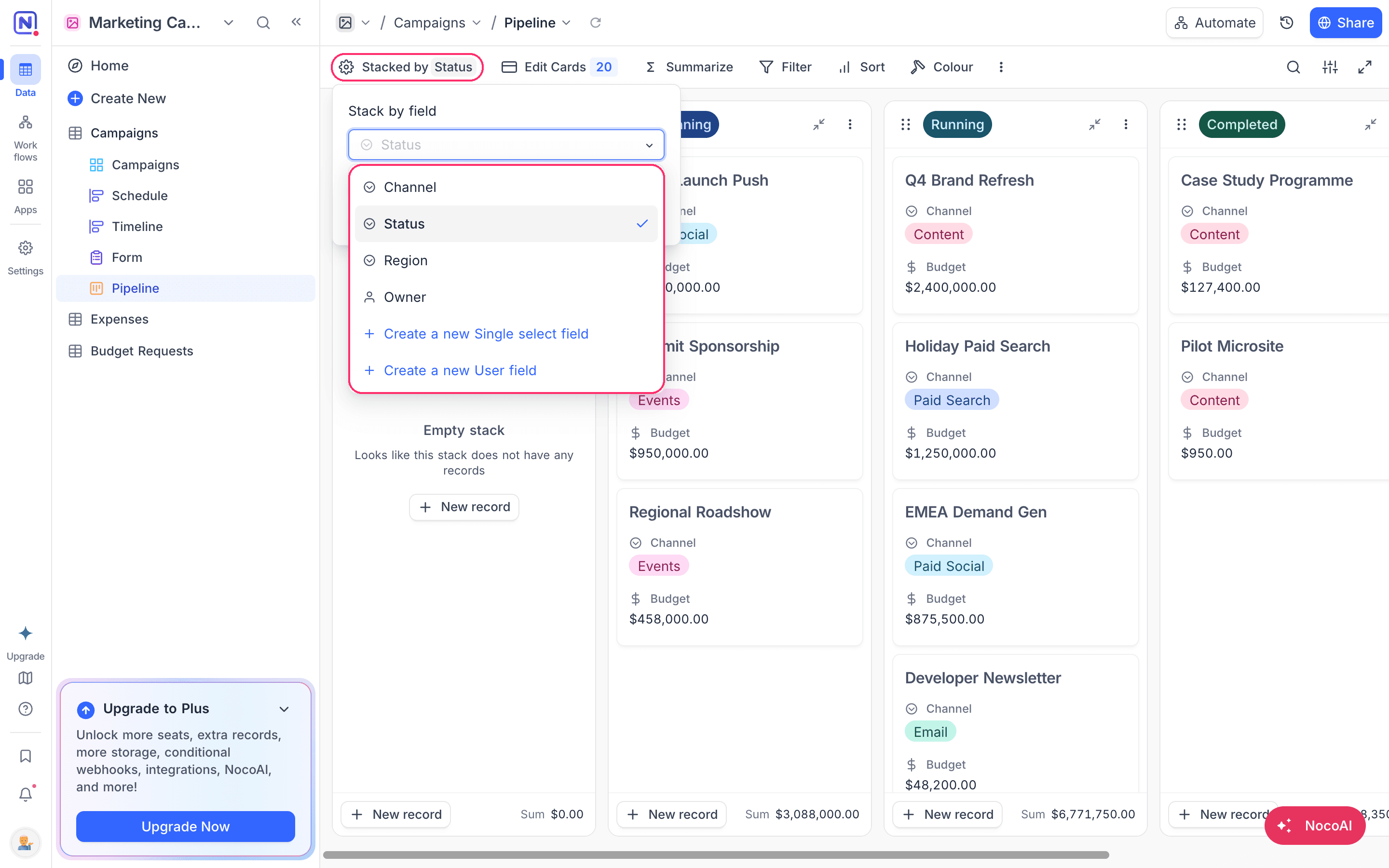
Add/modify Stacked-by Field Options
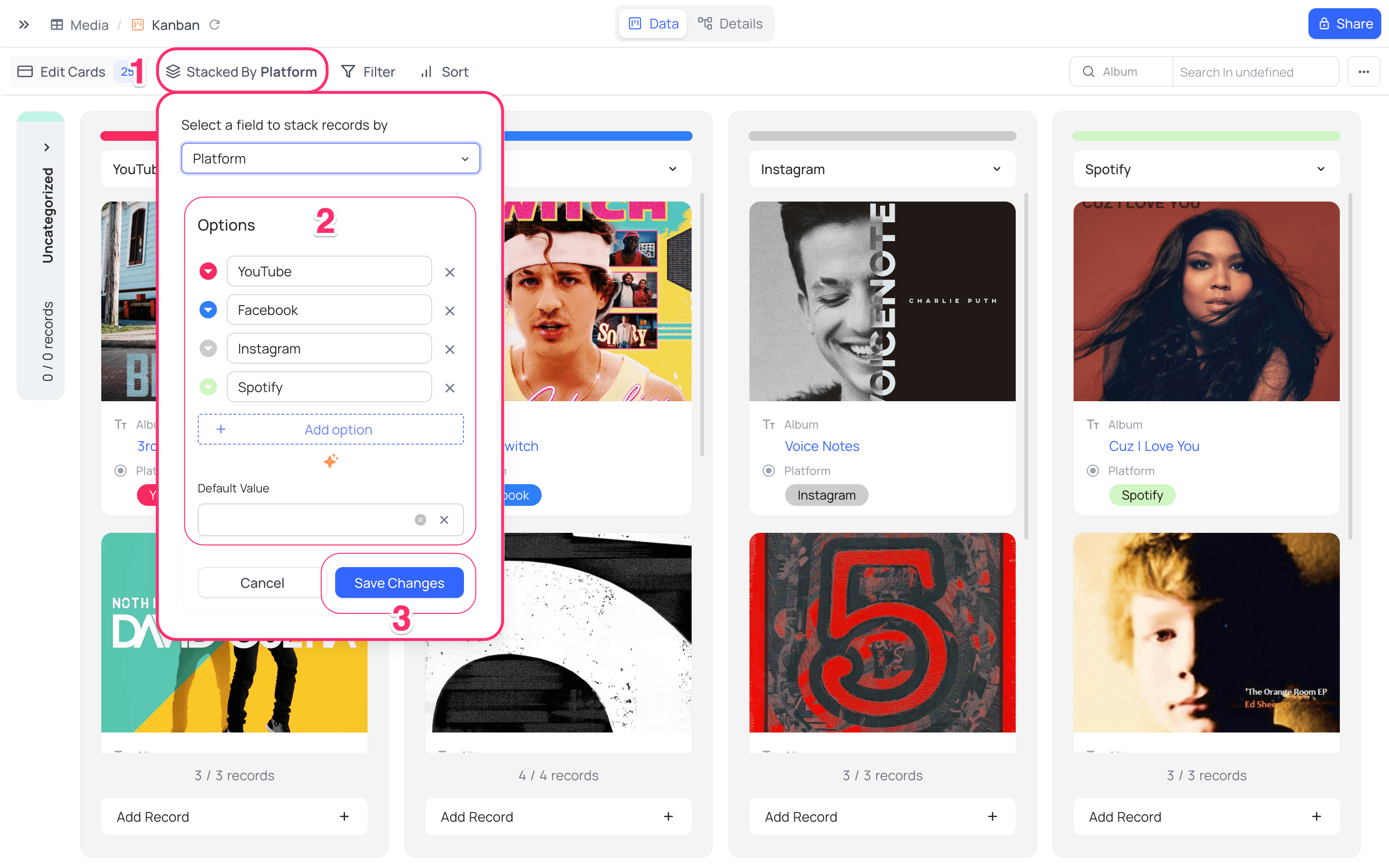
To add or change options on the stacked-by single select field:
- In the toolbar, click the
Stacked bymenu. The dropdown shows allSelect Optionsof this field. - Add or change the options as necessary.
- Click
Save.
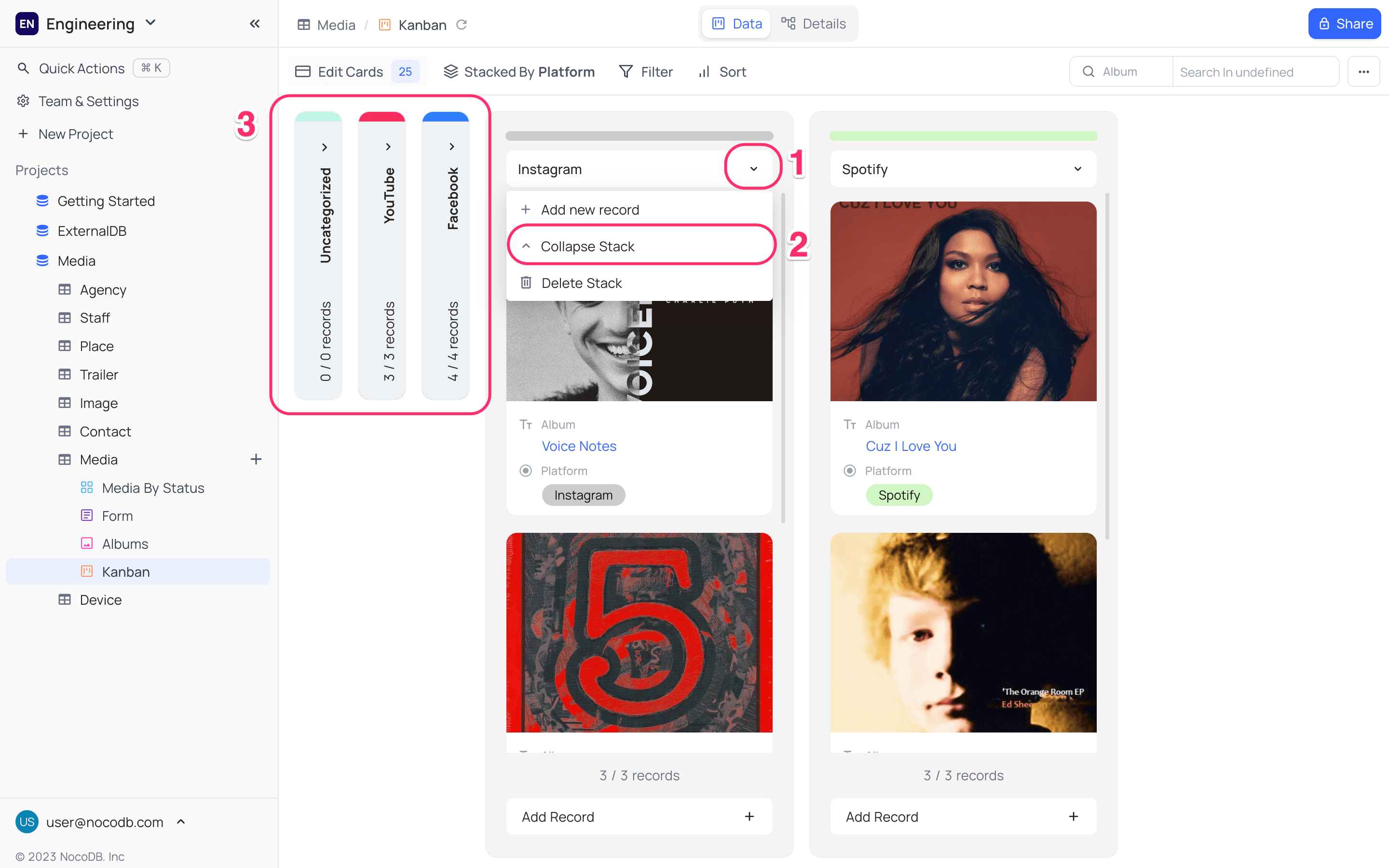
Collapse Stack
To make the kanban easier to read, collapse a stack:
- On the stack header, click the dropdown icon.
- Select
Collapse Stack. The kanban view shows theCollapsed Stackas a vertical bar, as in the image below.
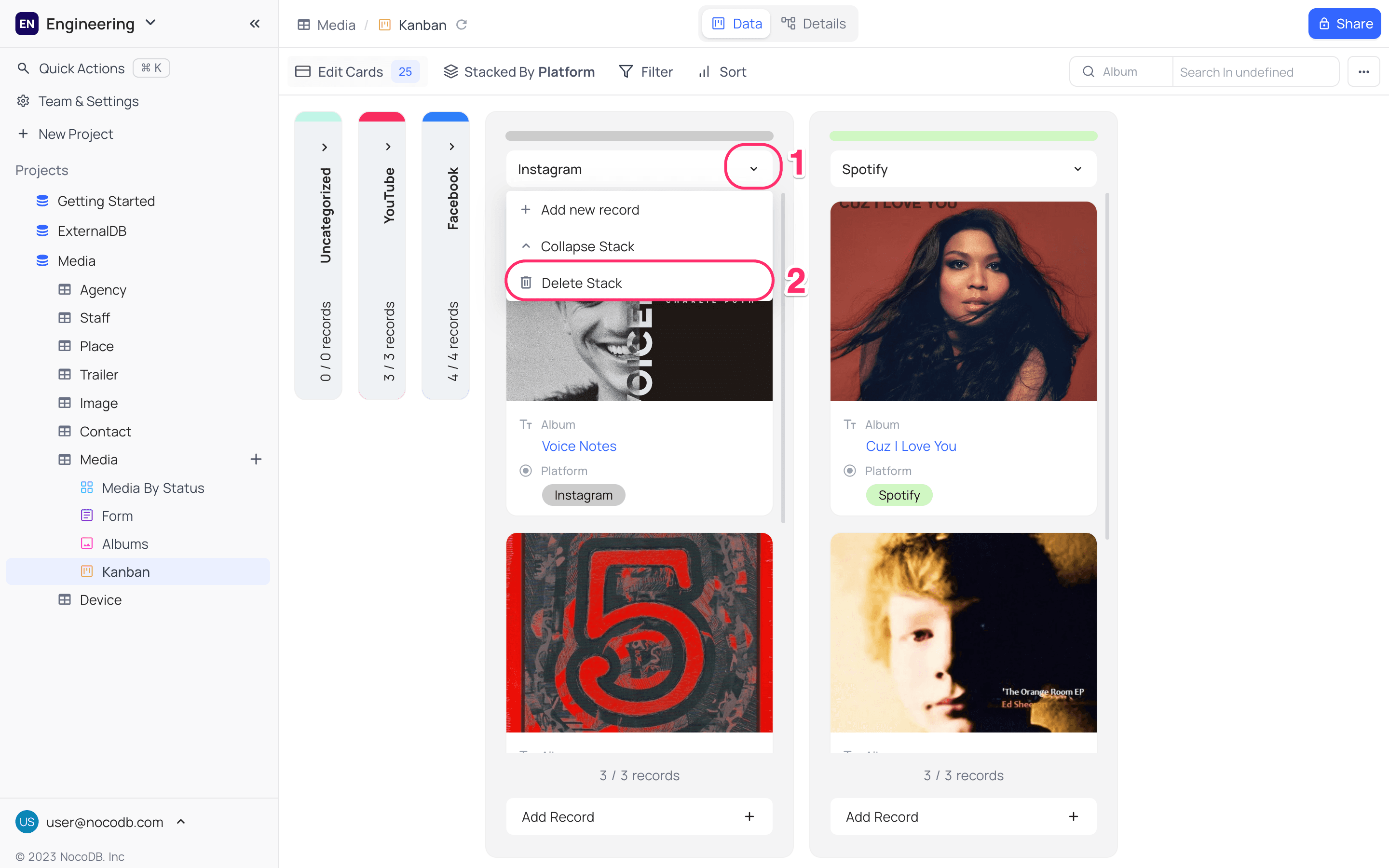
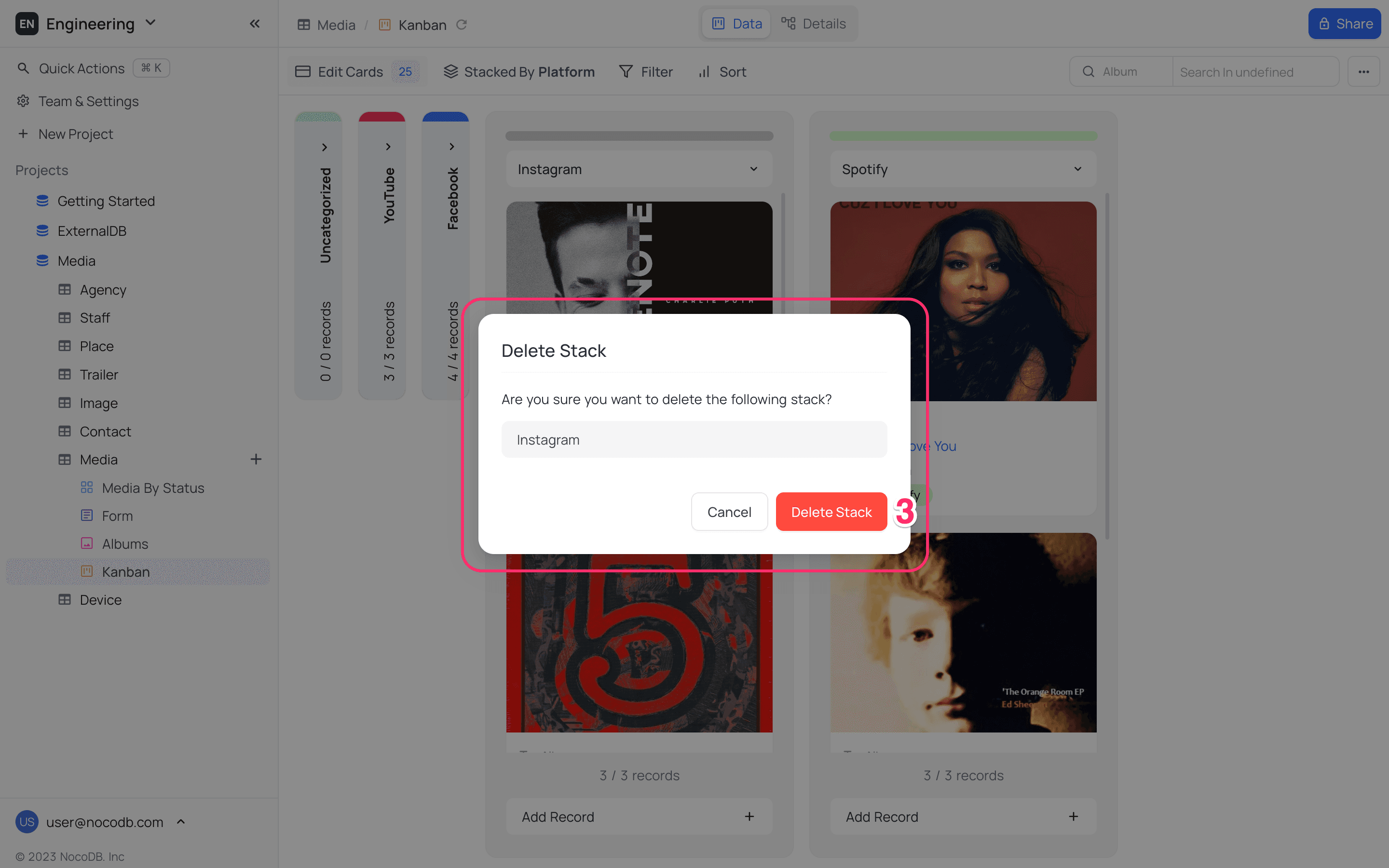
Delete Stack
To delete a stack from the kanban view:
- On the stack header, click the dropdown icon.
- Select
Delete Stack. A confirmation dialog opens. - Click
Delete.
Reorder Stacks
To change the order of the stacks in the kanban view, drag a stack to a new position.
Summarize each stack
To show a calculated value on every stack of the board, for example the total value of the deals in each stage:
- In the toolbar, click
Summarize. - In Field, select Record count or the field to calculate.
- In Function, select the calculation. The list has the functions that work with the selected field type.
- Optionally, in Label, select None, Function name or Custom. With Custom, enter the text to show before the value.
- Optionally, in Colour, set a default colour and add rules that compare the result with a number.
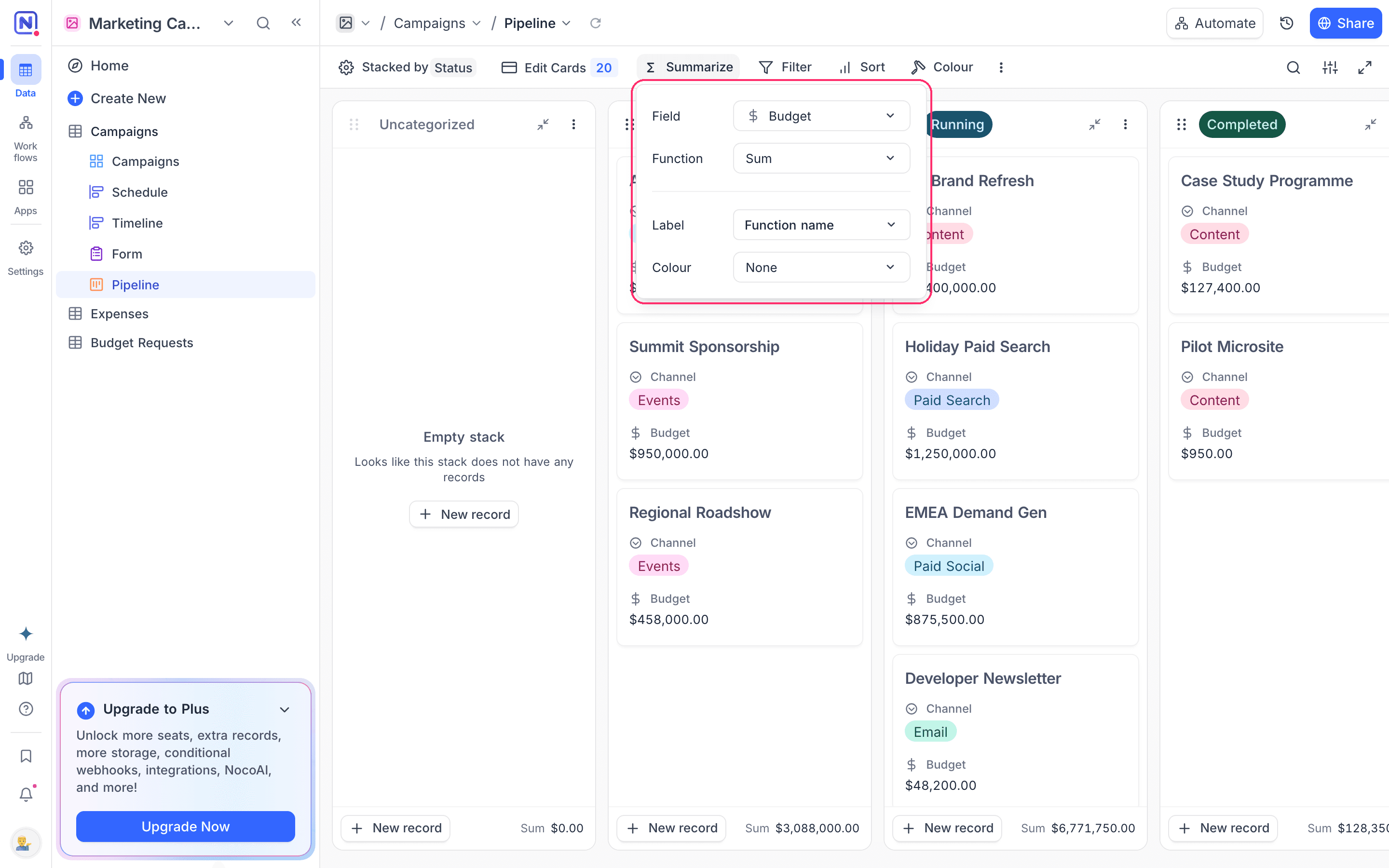
Each stack then shows its own value in the stack footer. When a stack has no value to show, for example the average of an empty stack, it shows a dash.
Colour rules apply in order, and the first rule that matches sets the colour of the value. Rules are not available when the result is a date, for example the earliest or latest date in a stack.
The field that the board is stacked by is not in the Field list, because its summary is the same in every stack. For a field that is hidden in the view, the Function list has only the functions that combine many records, such as Sum, Average and the counts, so a hidden value is not shown one record at a time.
A shared link of the Kanban view shows the saved summary. Viewers cannot change it.
If the field of a saved summary is deleted, no longer works with the function, or is hidden in the view with a function that is not in that shorter list, the Summarize button turns red and the panel says why. Select a different field or function to fix it.
Kanban View Record Operations
Move Records within Stacks
To move a record in a stack, drag the card to a new position in the stack. If the view has a sort, the sort sets the order of the cards. A card that you drag goes back to the position that the sort gives it. To arrange cards by hand, remove the sort.
Add a New Record to the Kanban
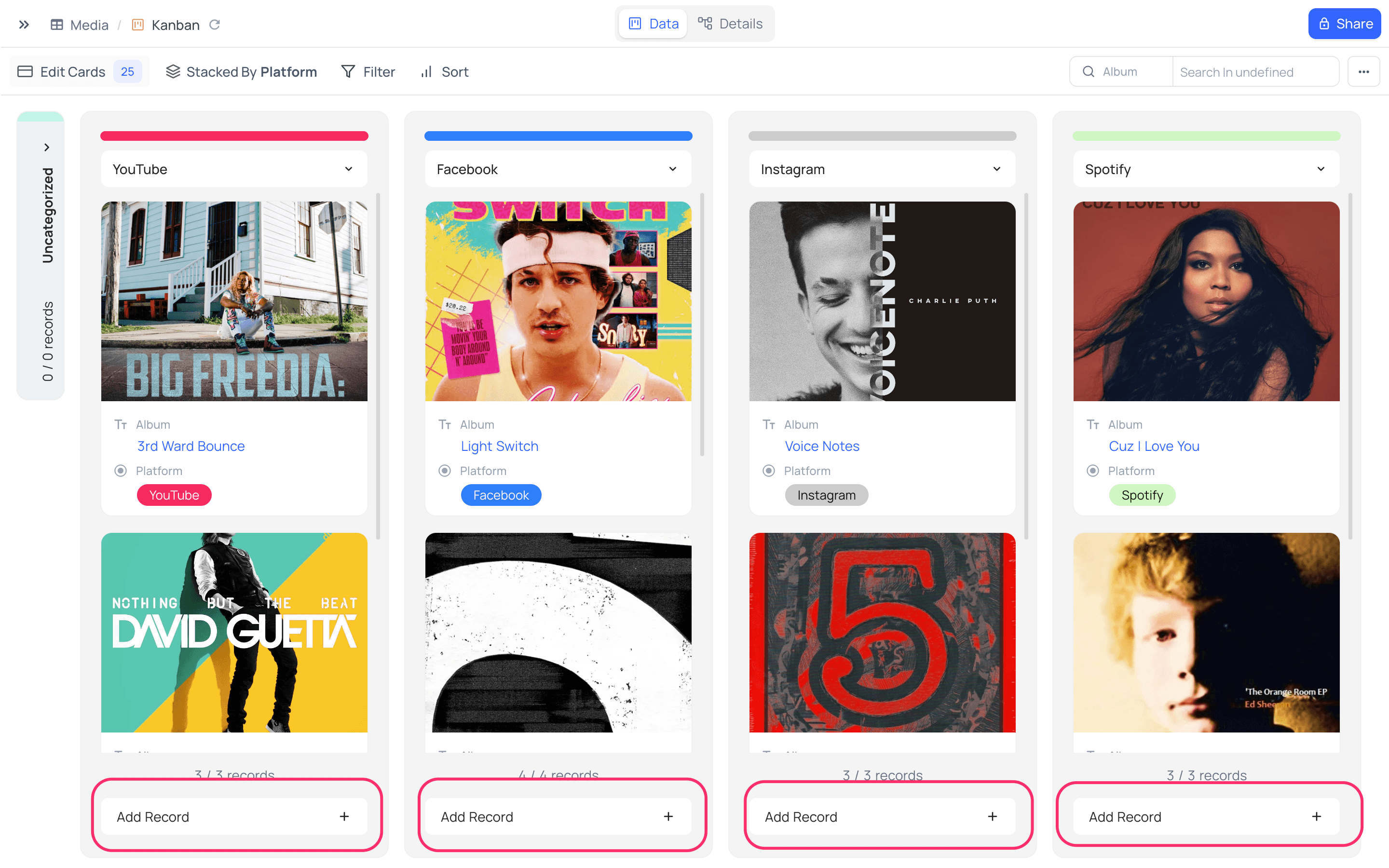
To add a new record directly to a stack, click the Add Record button in the stack footer. The expanded record view opens. Enter the data for the new record. When you save the record, the kanban view shows it. You can also add a new record to the table, and the kanban view shows it.
Edit an Existing Record on the Kanban
Click the card in the kanban view. The record opens in the expanded record view. Edit the record and save it.
Delete a Single Record from the Kanban
Right-click the card. In the context menu, select Delete.
Availability
Summarizeis available on NocoDB Cloud (all plans) and on self-hosted Enterprise Edition deployments, licensed or not. It is not in Community Edition.
Related
Last updated on