Table Sync
Mirror a shared view from one NocoDB base into another, kept up to date automatically.
Table Sync mirrors a Grid view from one base into another as a read-only table. The mirror updates automatically as the source changes, so downstream teams stay current without exports or manual refreshes.
Creating a Sync
Create the sync in the destination base — the base that will receive the live copy. The Create sync dialog can be opened from two places:
-
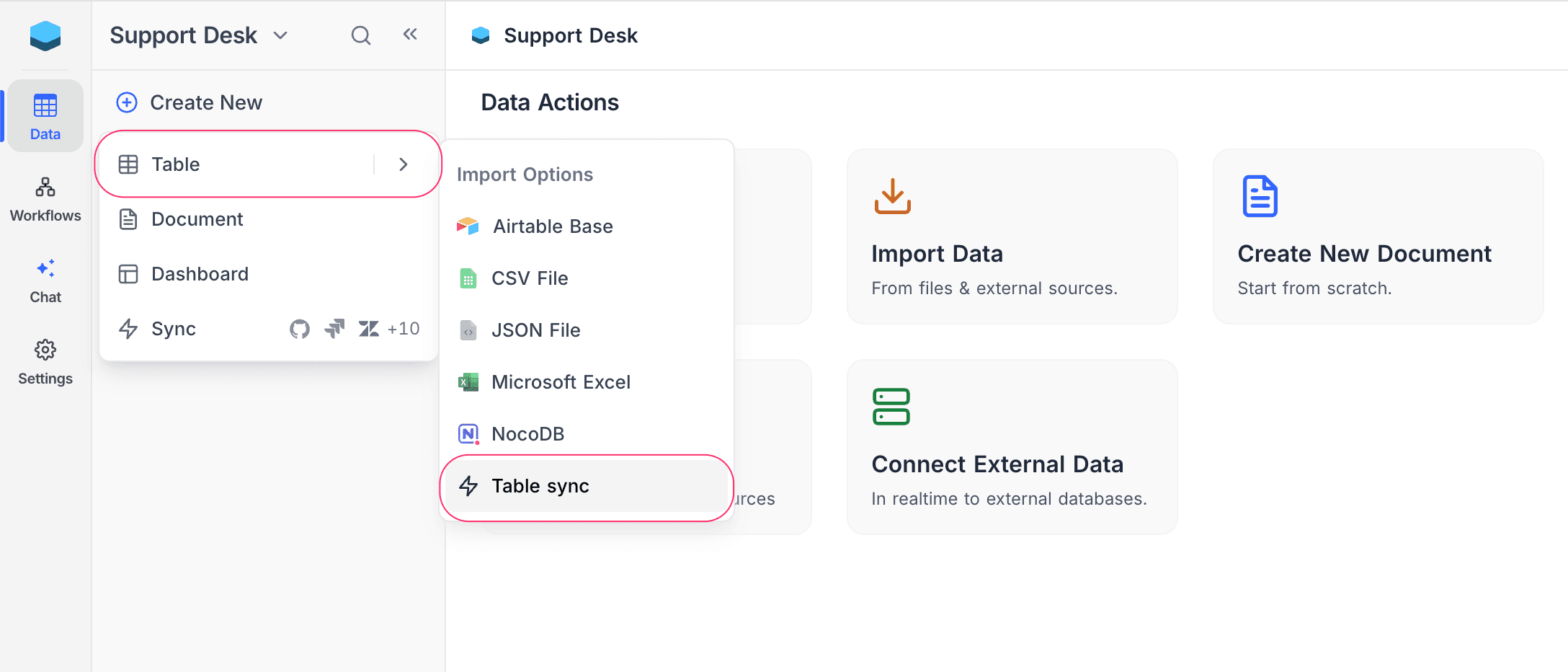
Sidebar — click + Create New, hover Sync, and pick Table sync.
-
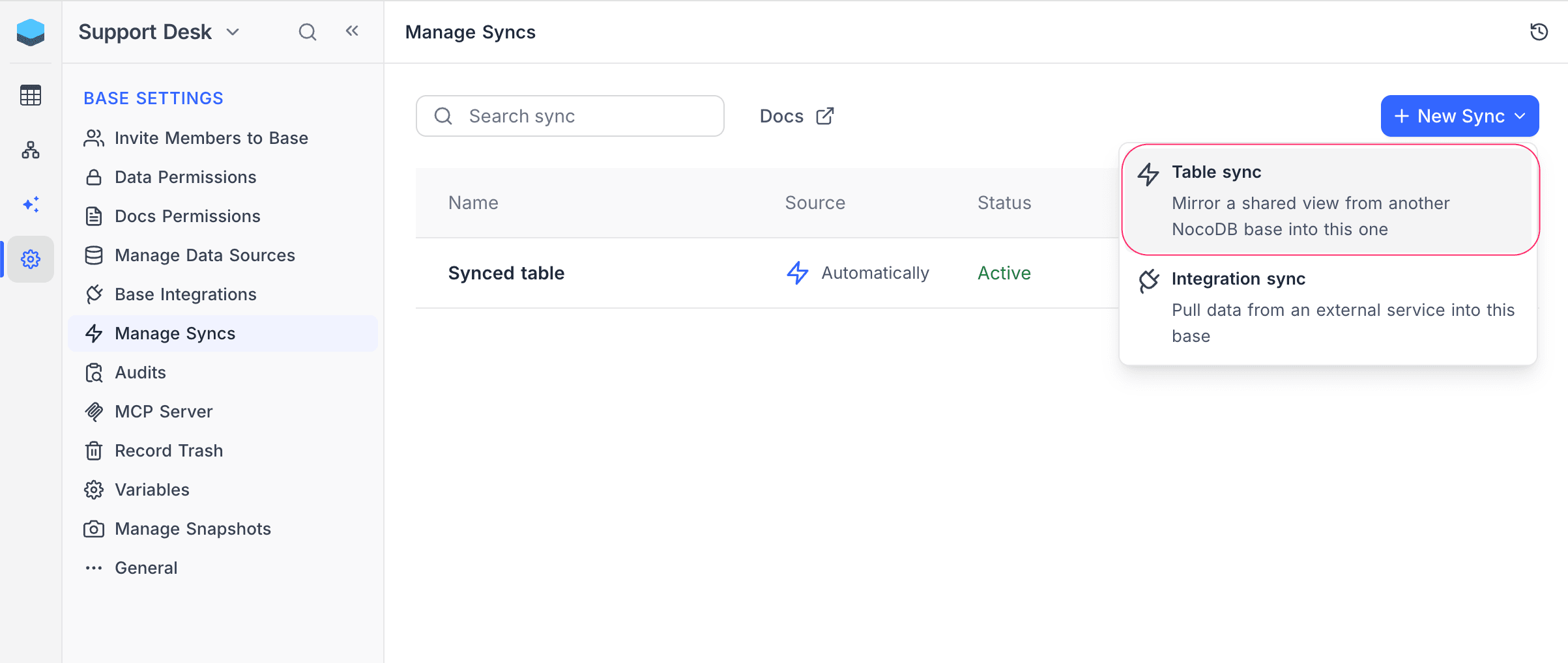
Base settings — open Settings → Manage Syncs, then click + New Sync → Table sync.
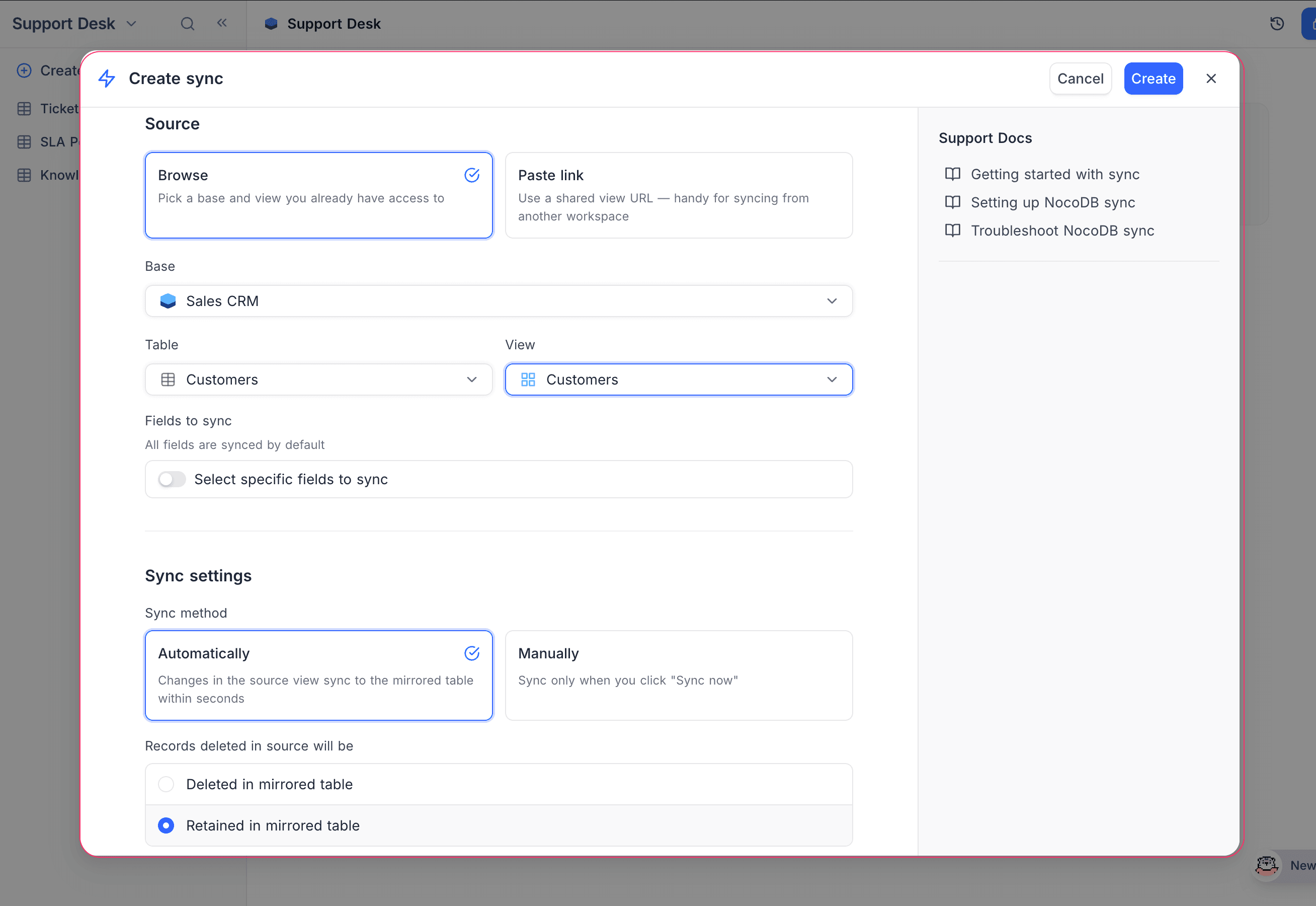
The dialog is organized into three sections: General, Source, and Sync settings.
General
Enter a Sync name. The same name is used as the title of the mirrored table by default.
Source
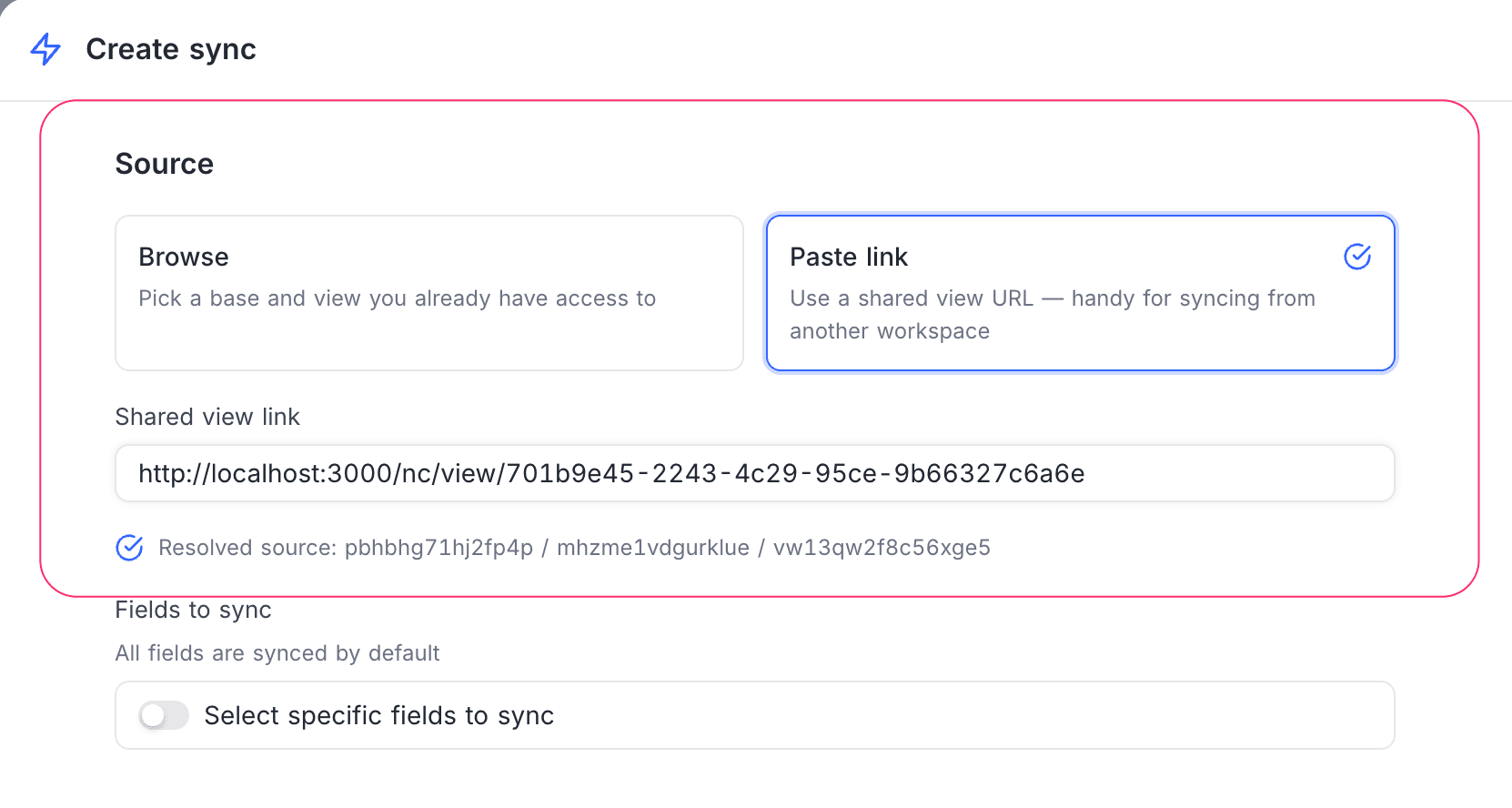
Pick the Grid view to mirror. The source view must have Allow sync enabled (see Sharing a View for Sync). Two source modes are available:
-
Browse — walk down Base → Table → View from bases you already have access to in this workspace. The view picker only lists Grid views.
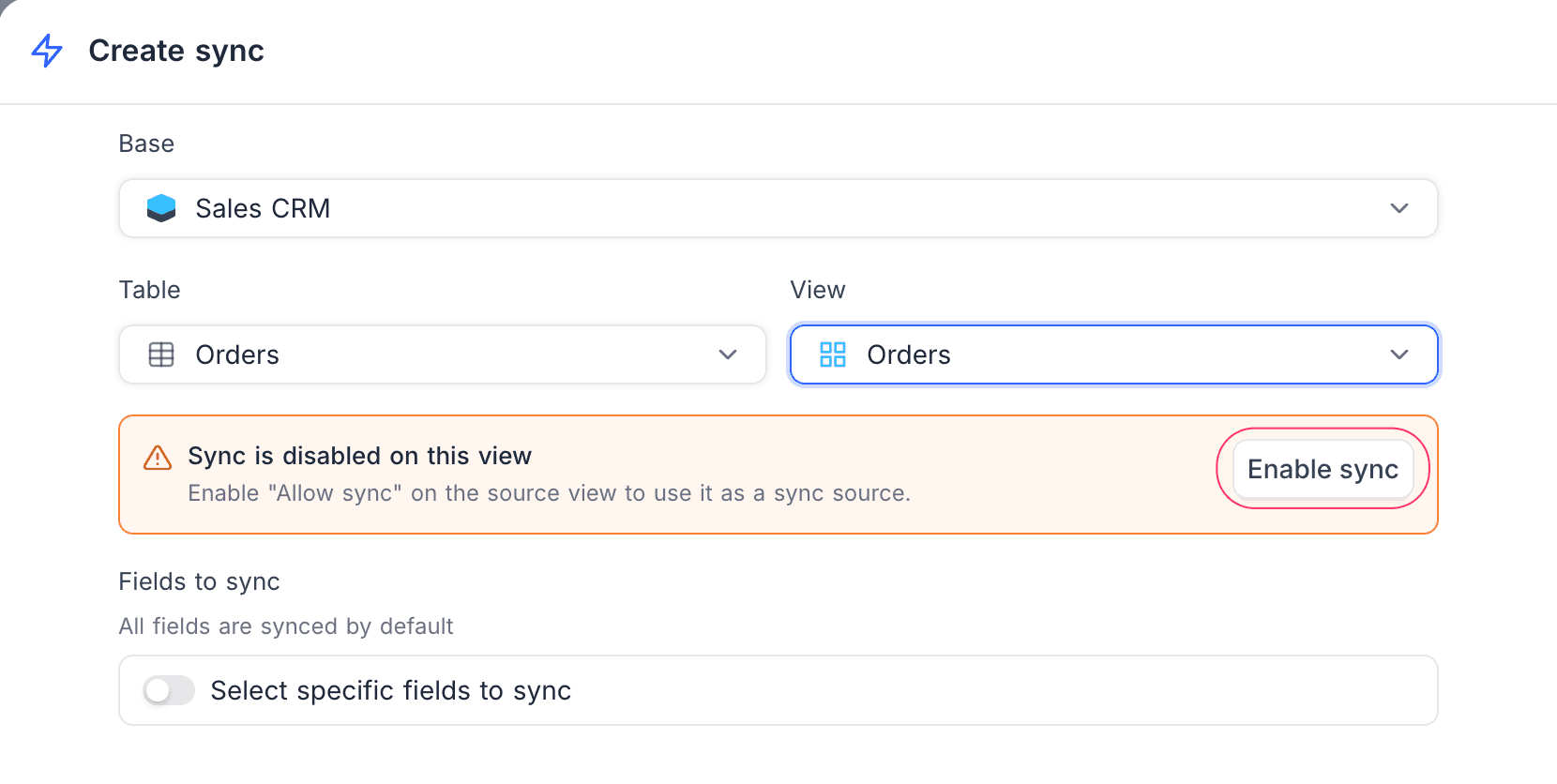
If the picked view doesn't have Allow sync turned on yet, an inline Enable sync button appears so you can enable it without leaving the dialog.
-
Paste link — paste a shared view URL, and a password if the link is protected. Use this mode to sync from a base in another workspace. The dialog resolves and displays the source it points at.
Fields to sync
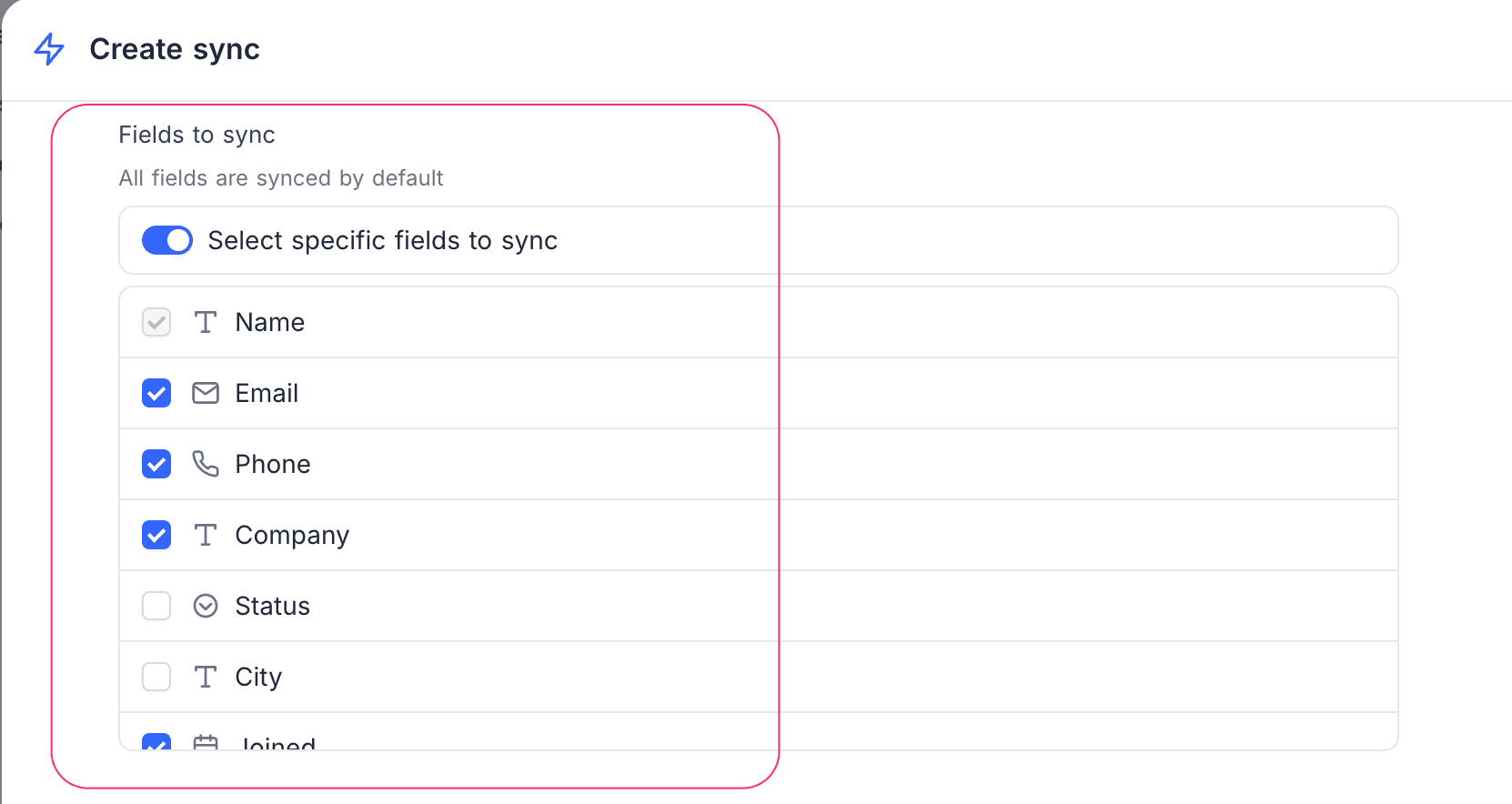
By default, every field in the source view is mirrored. Field additions, removals, and type changes at the source flow through to the mirrored table automatically.
Turn on Select specific fields to sync to pick a subset:
- The primary field is always included.
- Field types that can't be synced — Barcode, QR Code, and Button — are locked off.
- For linked record fields, pick a Grid view of the related table to bring those records across as a companion mirrored table — the link is preserved in the destination. The related view must also have Allow sync enabled. If no related view is picked, the field is brought across as comma-separated text of the linked records' primary fields.
Sync settings
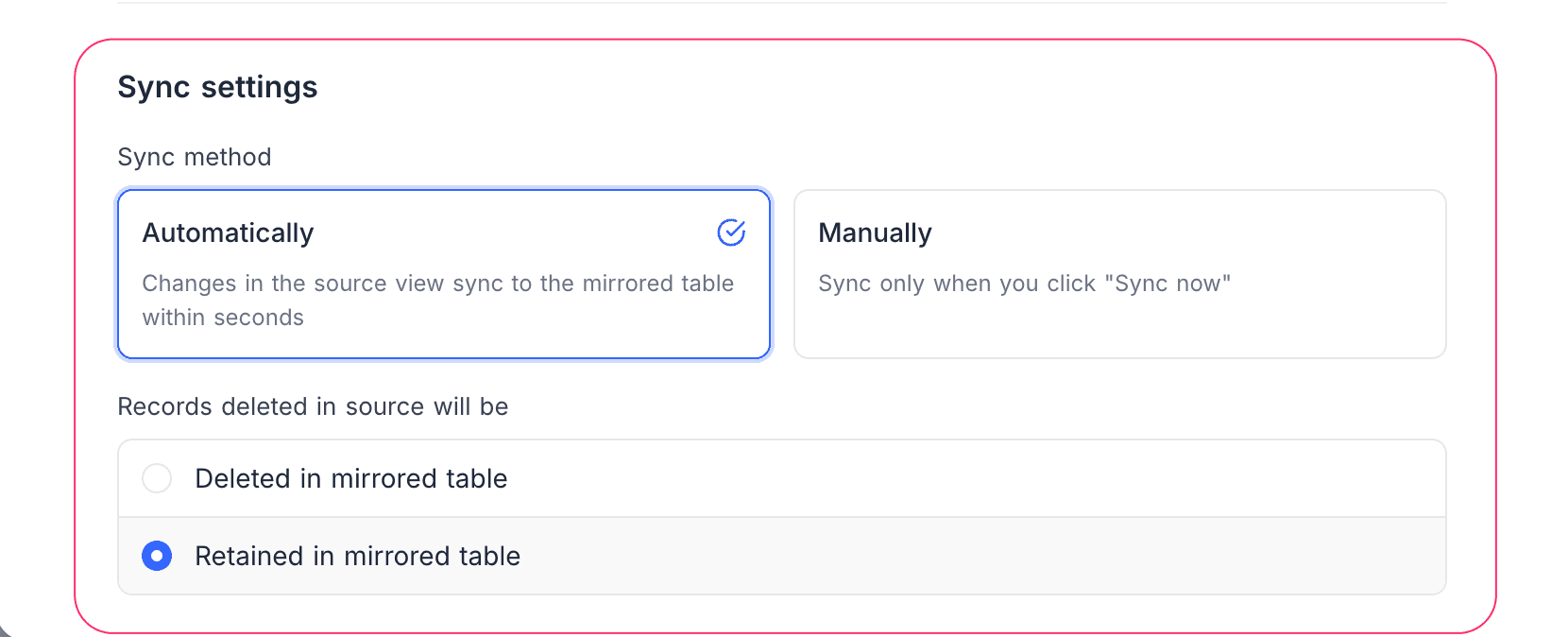
- Sync method
- Automatically — changes at the source propagate to the destination within seconds.
- Manually — the destination only refreshes when someone clicks Sync now.
- Records deleted in source will be
- Retained in mirrored table (default) — the mirrored row stays in place, preserving history in the destination.
- Deleted in mirrored table — the row is removed from the destination too, keeping it a strict mirror.
A record is considered deleted at the source when it is either removed from the source table or filtered out of the source view.
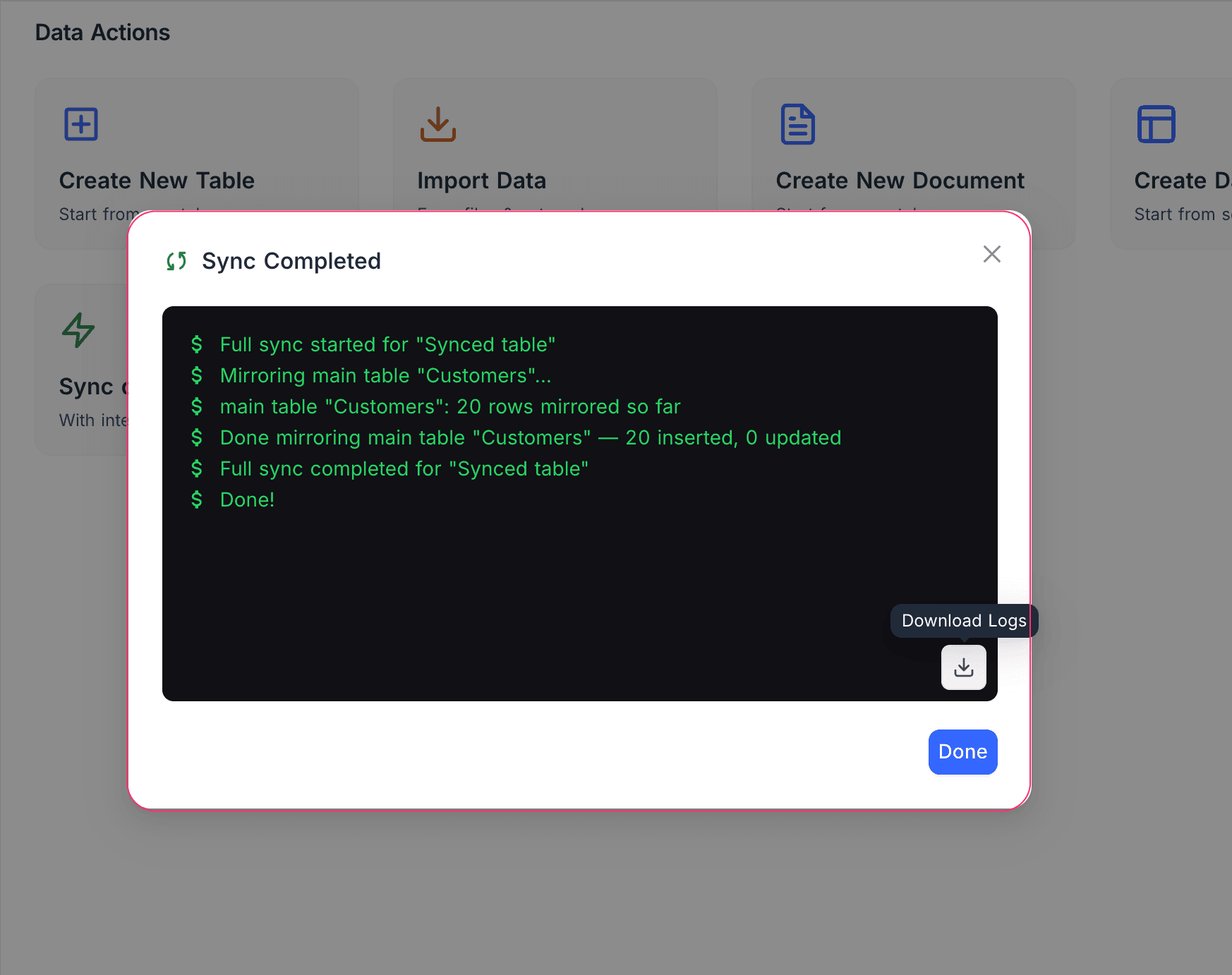
Click Create. A progress panel runs while the initial copy is brought across; once it finishes, you can download the logs and close the panel.
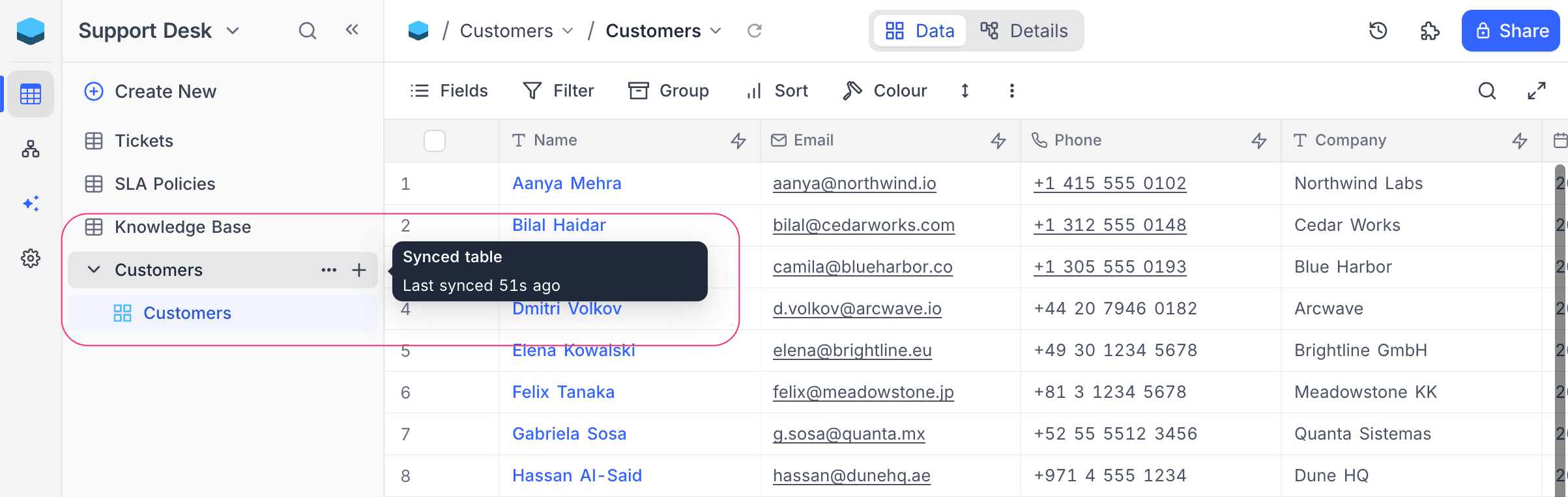
The mirrored table appears in the destination's sidebar with a lightning-bolt icon. If the sync brings linked records across, the companion mirrored table appears too.
Sharing a View for Sync
The owner of the source view enables sharing before another base can mirror it.
- Open the source table and switch to the Grid view to share.
- Click Share in the top bar.
- Turn on Enable Public Viewing.
- Toggle Allow sync on.
- Optionally enable Restrict access with password — anyone creating a sync from this link will need it.
- Send the shared view link (and password, if set) to the team that will create the sync.
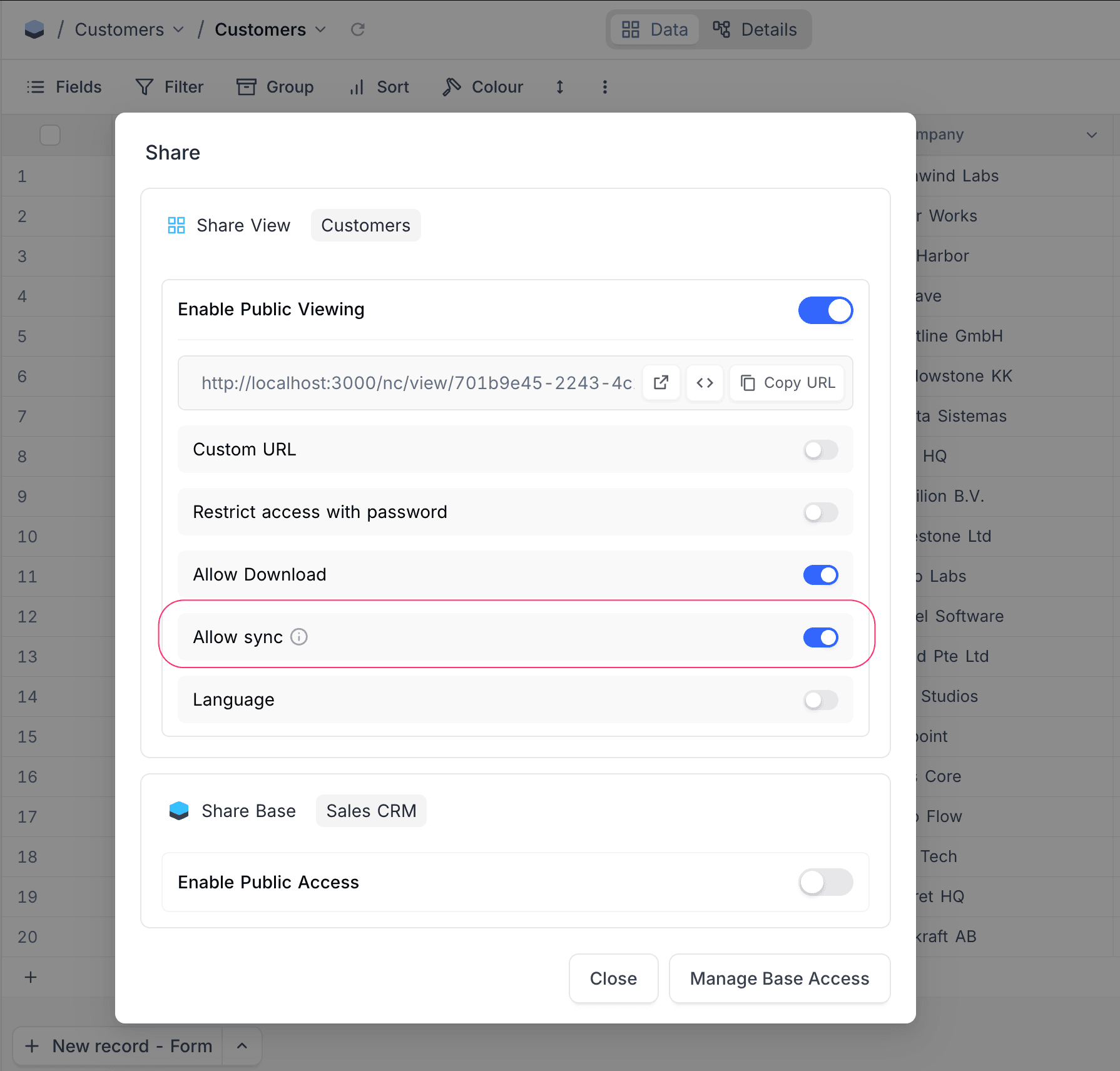
Allow sync is only available on Grid views with public sharing enabled. Form, Kanban, Gallery, Calendar, and Map views cannot back a sync.
Working with the Mirrored Table
Mirrored fields are read-only and refresh automatically. To change a value, edit it at the source.
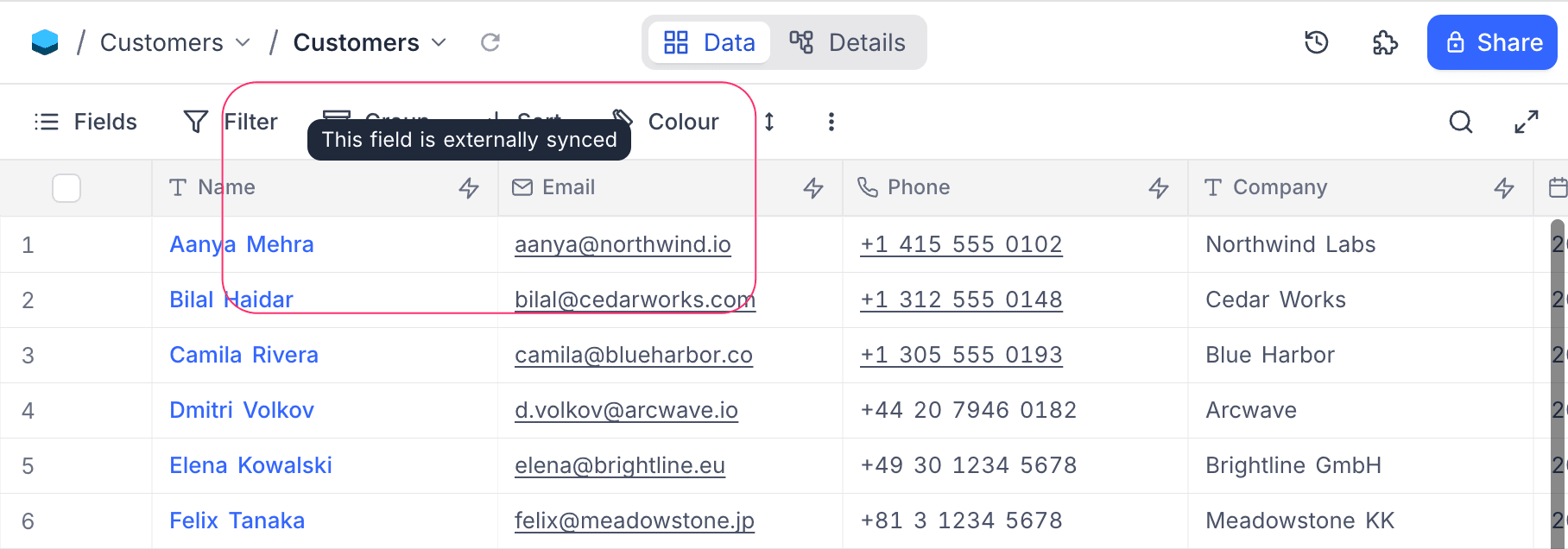
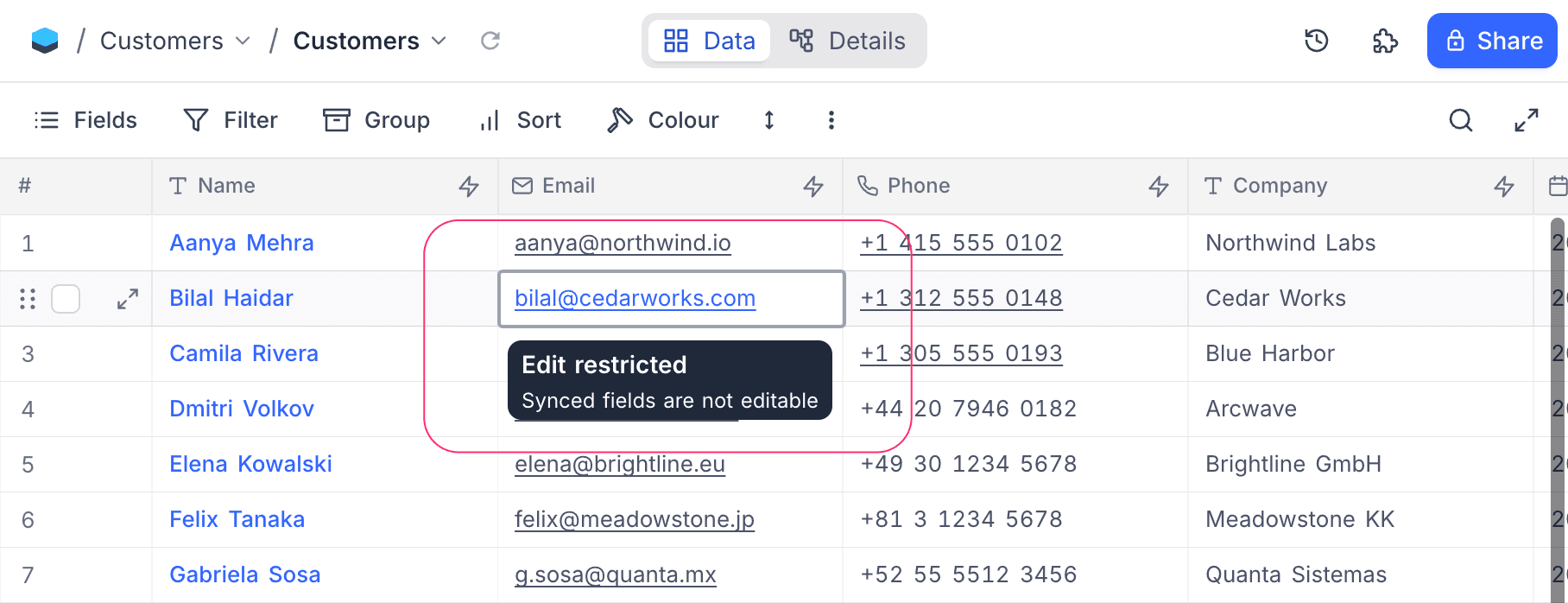
The mirrored table behaves like a regular table in most other ways. You can add non-synced fields, create your own views and filters on top, and link other tables to it.
The following operations are blocked on synced tables:
- Records cannot be inserted, duplicated, deleted, or pasted into.
- Synced fields cannot be renamed, retyped, or have default values set.
- Form views cannot be created on synced tables.
- Field and table permissions do not apply to synced columns or tables.
Managing Syncs
All syncs in a base are listed under Settings → Manage Syncs, with columns for Name, Source (showing the sync method), Status, and Last trigger.
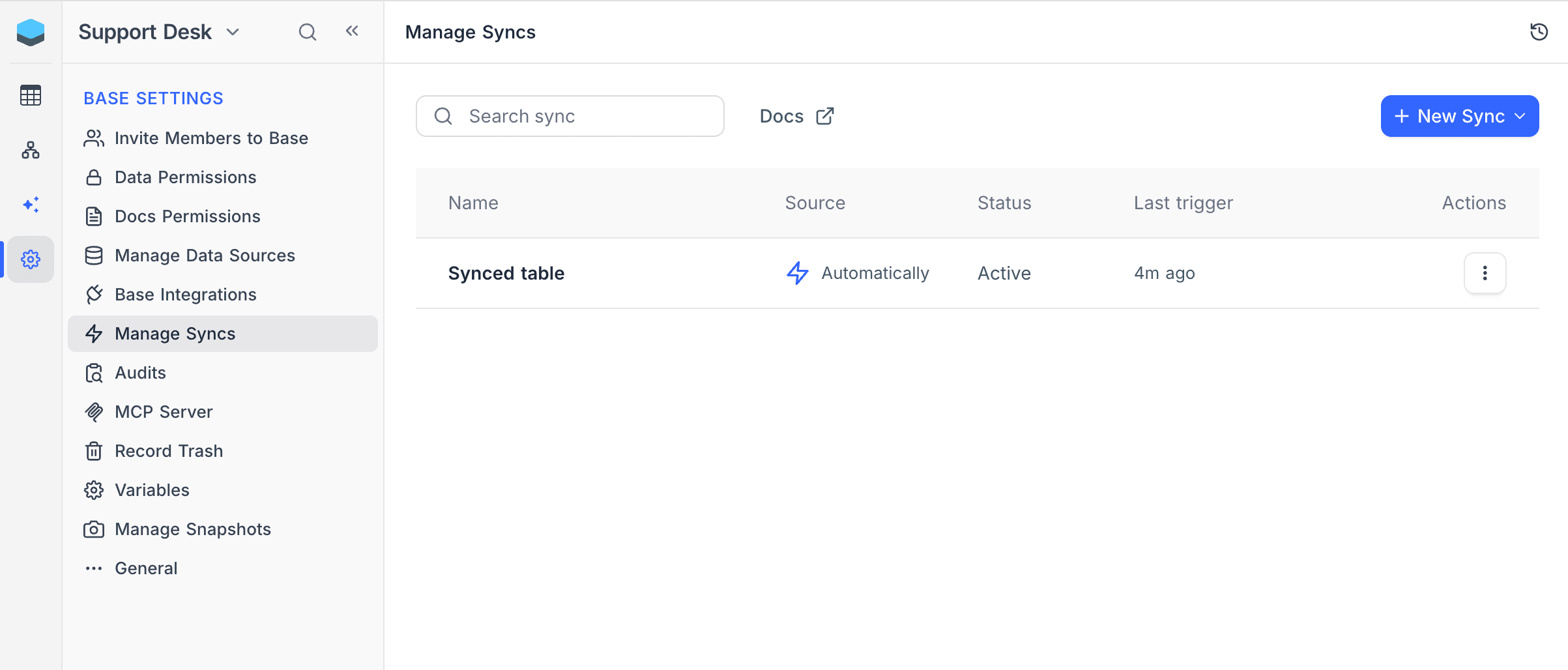
Each sync is in one of these states:
| Status | What it means |
|---|---|
| Active | Sync is healthy. Source changes flow through automatically, or on demand for manual syncs. |
| Syncing | An initial copy or a fresh update is in progress. |
| Paused | Sync is frozen until someone resumes it. |
| Error | The last update failed. Hover the status to see the error. |
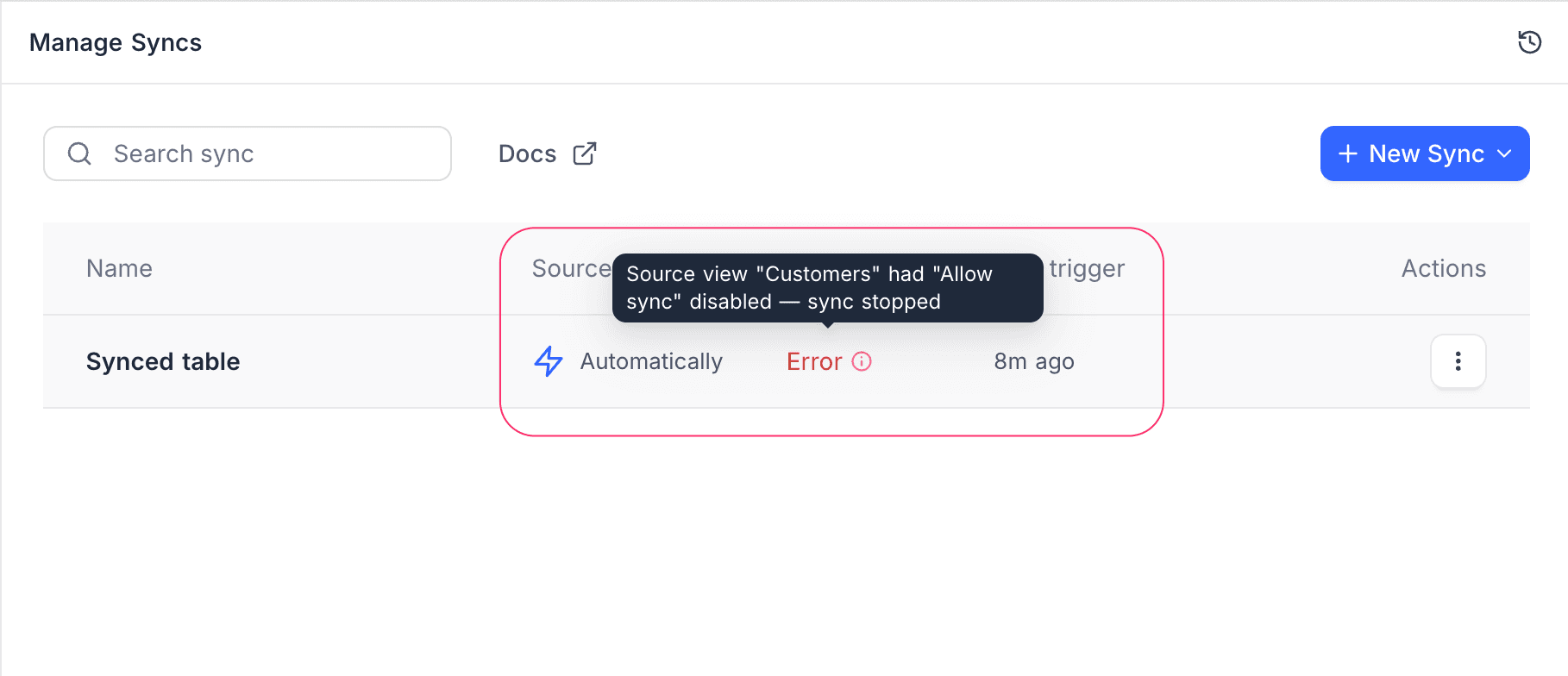
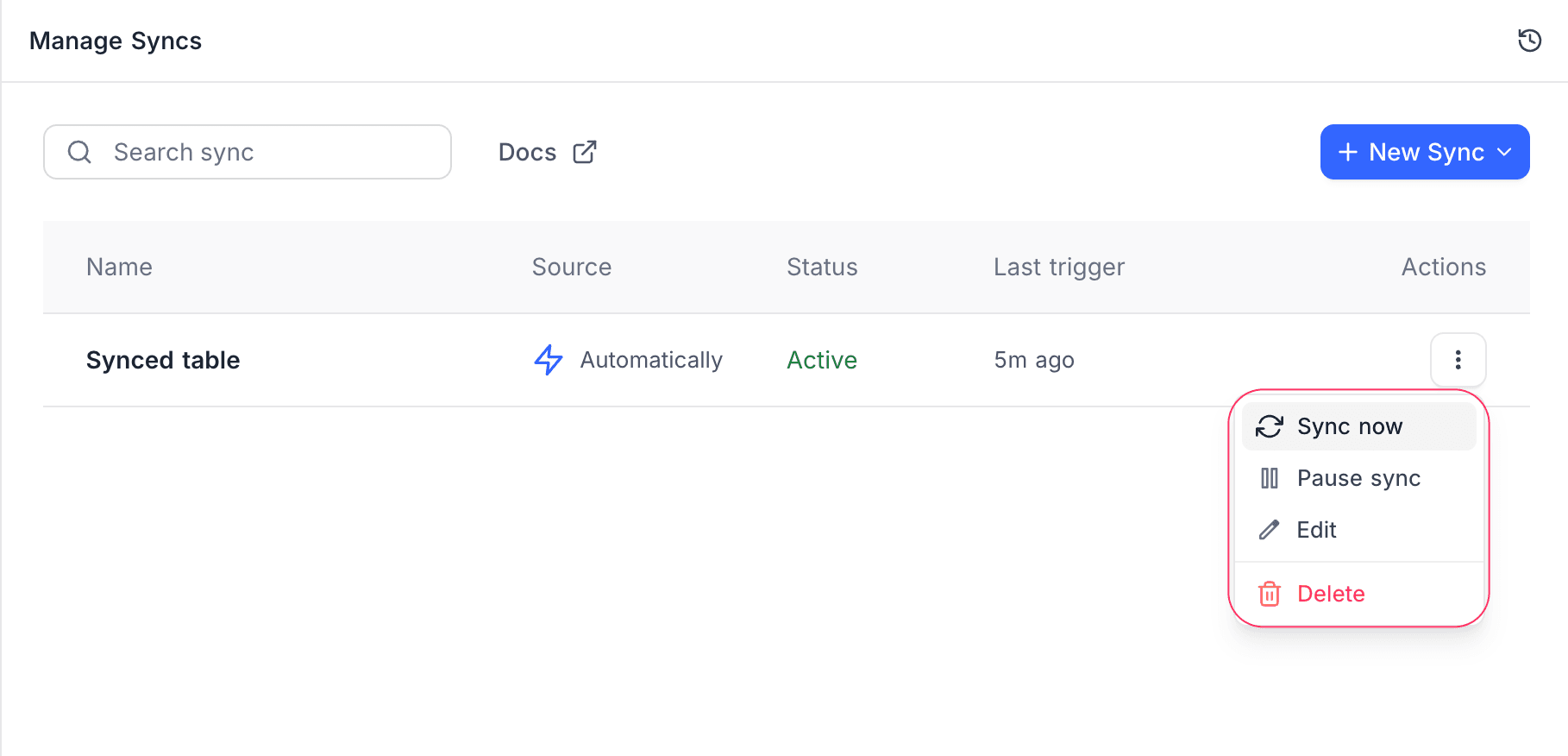
The three-dot Actions menu on each row exposes:
- Sync now — force an immediate update.
- Pause sync — stop receiving updates until resumed.
- Resume sync — resume after a pause. When the sync is in the Error state, this becomes Retry sync.
- Edit — see Editing a Sync.
- Delete — see Deleting a Sync.
Actions are disabled while a sync is mid-update.
Editing a Sync
From the Actions menu, pick Edit to change:
- Sync name
- Sync method
- Records deleted in source will be
- Source view — re-bind the sync to a different Grid view of the same source table. The new view must have Allow sync enabled. Re-binding triggers a full re-sync against the new view.
- Fields to sync — add, remove, or change linked-record view picks.
The source mode, source base, and source table cannot be changed in edit mode — only the source view within the same table can be re-bound.
If the source becomes unrecoverable — the source table has been deleted, or the sync's main column mapping is missing — the edit dialog enters a recovery state. The only available action then is Delete sync.
Deleting a Sync
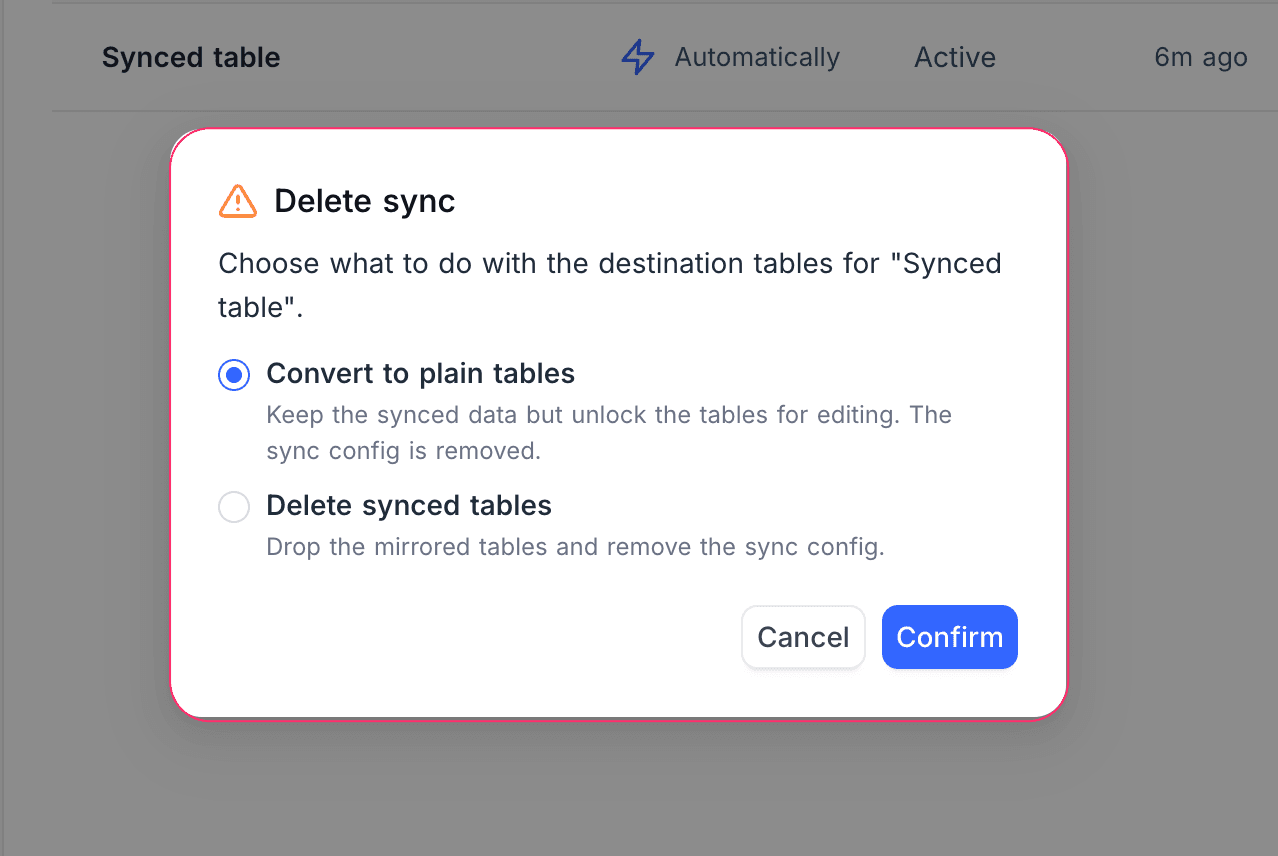
From the Actions menu, pick Delete. The dialog asks how to handle the mirrored tables:
- Convert to plain tables — keep the mirrored data, unlock it for editing, and remove the sync configuration. The tables stop receiving updates from the source.
- Delete synced tables — drop the mirrored tables and remove the sync configuration.
The source is not affected either way.
Field Type Mapping
Most field types are mirrored as their native type. A few are handled specially:
| Source field type | In the mirrored table |
|---|---|
| Formula, Rollup, User (single/multi), Created by, Last modified by, UUID | Plain text |
| Lookup | Plain text (long) |
| Created time, Last modified time | Date/time |
| AutoNumber | Number |
| Links (the link-counter field) | Number |
| Linked record (with a related view picked) | Linked record (companion mirrored table is created) |
| Linked record (no related view picked) | Plain text (comma-separated primary fields) |
| Barcode, QR Code, Button | Not synced |
Cross-base links and custom links from the source are not mirrored. If you need them in the destination, recreate them on the mirrored table.