# Display Value
> Part of the NocoDB documentation (Product docs > Tables > Fields). Index of all pages: https://nocodb.com/llms.txt. Any docs page is available as Markdown by adding `.md` to its URL.
URL: https://nocodb.com/docs/product/tables/fields/display-value
Last updated: 2026-09-25
This article explains how to set the display value for a table and its significance.
The **Display Value** serves as the primary visual identifier for a record within a table. It helps users quickly recognize and associate records across views and linked tables. While it is often recommended to set a display value based on a field with unique identifiers (like a primary key), uniqueness is not enforced at the database level.
***
Use [Name] as the display value of this table
Which field is the display value of this table, and should it be a different one?
Add a formula field that combines [First Name] and [Last Name] and make it the display value
## Use of Display Value
* In the spreadsheet view, the display value is visually emphasized to make it easier to identify the record you’re working with.
* When creating **Links** between tables, the display value is shown in the **Linked Records** modal, making cross-table relationships more readable and intuitive.
**Example: Display Value highlighted in the Actor table**
**Example: Display Value shown in a Links field.**
The value shown in the **Link Records** modal is pulled from the related table's display value.
## Set Display Value
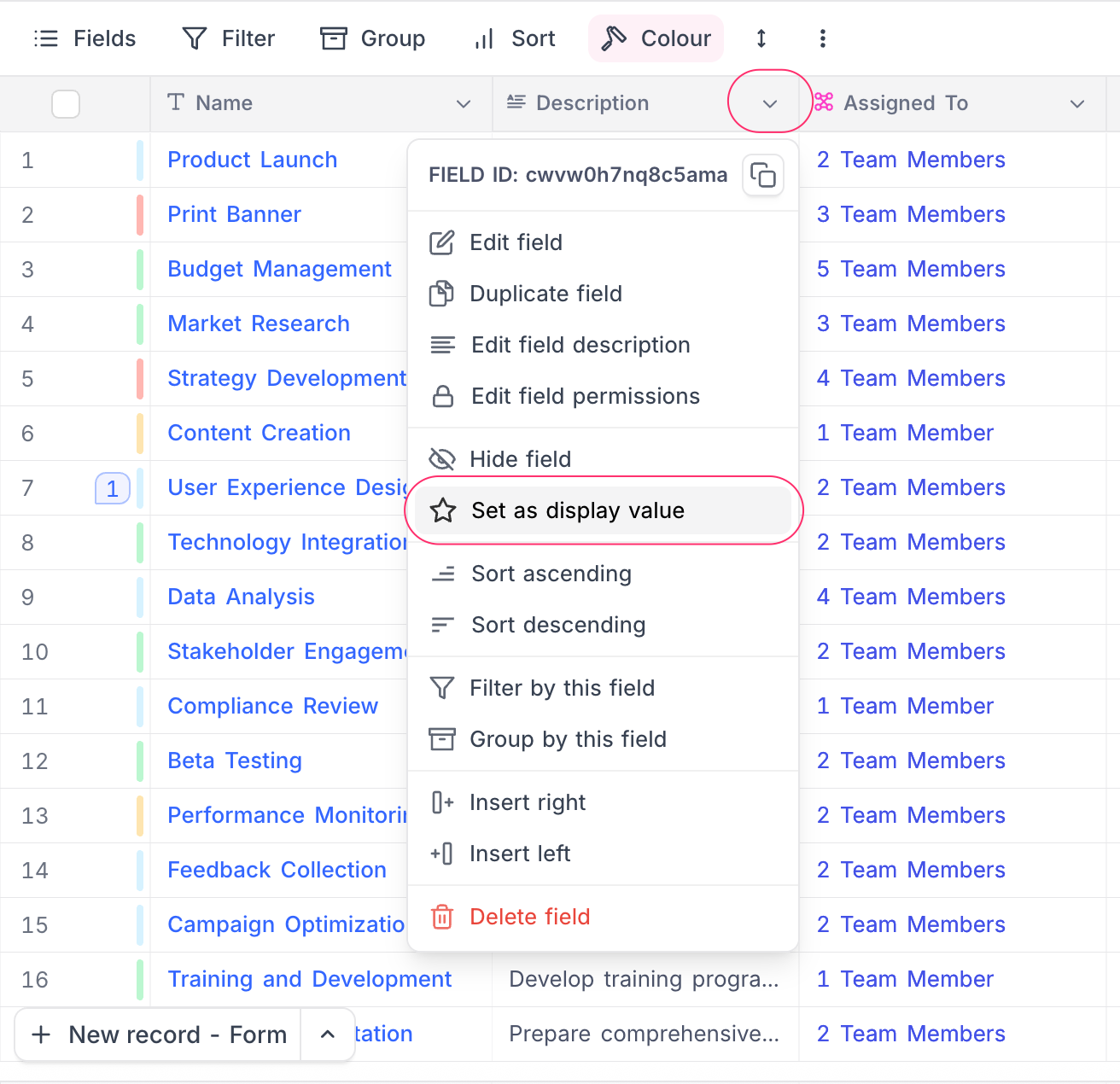
To set a field as the display value:
1. Click the dropdown icon (🔽) next to the desired field.
2. Select **Set as display value** from the menu.
## Supported field types
Only field types that render as a single, compact value can be set as the display value. Multi-line content and computed collections are not supported.
**Supported**
* Single Line Text
* Number, Decimal, Currency, Percent, Duration, Auto Number
* Date, DateTime, Time, Year
* Phone Number, Email, URL
* Formula
**Not supported**
* Long Text (including Rich Text and AI-generated text)
* Single Select, Multi Select, Checkbox, Rating
* Attachment, User, Barcode, QR Code, JSON, Geometry, Button
* Links, Lookup, Rollup
Long Text is blocked only as a *new* display value selection — a field already set as the display value continues to work. If you need long or computed content (such as a Lookup or Rollup value) as the label, wrap it in a **Formula** field and set that as the display value.
## FAQ
**How is the Display Value determined for existing database tables?**
For tables connected from external databases, NocoDB automatically selects the display value based on the table structure. By default, it picks the first non-numeric field after the primary key. If no non-numeric field is found, it selects the next field after the primary key.
**Can I change the Display Value later?**
Yes. You can change the display value at any time by using the context menu on the target field. [Learn more →](/docs/product/tables/fields/display-value#set-display-value)
---
## Related pages
- [Primary Key](https://nocodb.com/docs/product/tables/fields/primary-key.md): This article explains what a primary key is and how it is used in NocoDB.
- [Multi-Field Editor](https://nocodb.com/docs/product/tables/fields/multi-fields-editor.md): Understanding use of multi-field editor in NocoDB!
- [Field Summary](https://nocodb.com/docs/product/tables/fields/field-summary-footer.md): Understanding the field summary bar in NocoDB!
- [Actions on Field](https://nocodb.com/docs/product/tables/fields/actions-on-field.md): This article explains how to perform various actions on a field- like rename, change field type, default, field width, record height, show/hide.